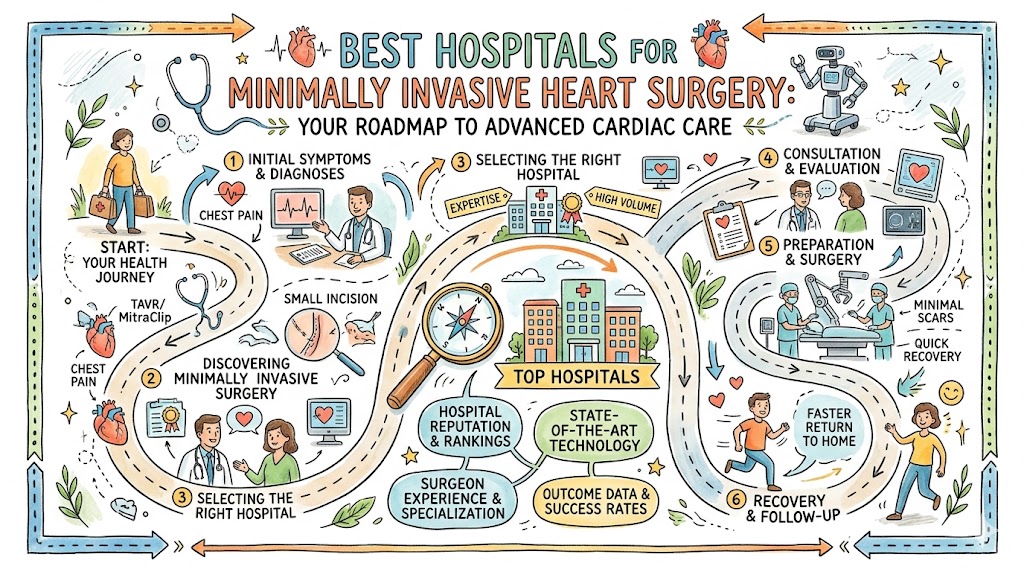
INTRODUCTION
Receiving a diagnosis that requires heart surgery is one of life’s most daunting moments. For many, the words “open-heart surgery” conjure images of long hospital stays, significant pain, and months of difficult recovery. These fears are entirely human and deeply understandable. However, cardiac medicine has undergone a quiet revolution in recent years, one that offers a more gentle path to healing.Minimally Invasive Heart Surgery (MICS) has changed the landscape for countless patients. Instead of the traditional “sternotomy”—where the breastbone must be divided—surgeons can now perform complex procedures through tiny incisions between the ribs. This approach preserves the integrity of the chest wall, drastically reducing the physical toll on the body.At Bestheartsurgery, our goal is to ensure you feel empowered rather than overwhelmed. Whether you are facing a valve repair or a bypass, knowing your options is the first step toward reclaiming your health. This guide is written to bridge the gap between clinical complexity and patient understanding. We will walk you through what “minimally invasive” actually means, how it compares to traditional surgery, and how to find a facility that prioritizes these advanced, less-taxing techniques.
WHAT IS MINIMALLY INVASIVE HEART SURGERY?
Minimally invasive heart surgery (MICS) is a technique that allows surgeons to perform complicated heart procedures through small incisions rather than a traditional, large opening in the center of the chest.
In a conventional open-heart procedure, the surgeon must cut through the sternum (the breastbone) to gain full access to the heart. In MICS, the surgeon utilizes the natural spaces between your ribs to reach the heart. By using specialized, long-reach instruments and high-definition cameras, they can see and manipulate the heart tissues with incredible precision, often without the need to “open” the chest completely.
It is a misconception that minimally invasive means “lesser” surgery. The actual repair of the heart valve or artery is identical to what is performed in open-heart surgery. The difference lies only in the access method. By keeping the chest wall intact, your body maintains its stability, which is the primary driver behind the shorter hospital stays and faster return to normalcy.
TYPES OF MINIMALLY INVASIVE HEART SURGERY
There isn’t just one “type” of MICS; the approach depends on your specific condition and your heart’s anatomy.
Keyhole (Thoracoscopic) Surgery
This is the most common form of MICS. The surgeon makes one or several tiny “keyhole” cuts in the side of your chest. A tiny camera (thoracoscope) is inserted, providing the surgeon with a magnified, clear view of the heart on a monitor. Specialized instruments allow the surgeon to conduct the repair through these small ports.
Robotic-Assisted Surgery
Robotic systems, such as the da Vinci surgical system, take MICS to a new level of precision. The surgeon sits at a console, controlling robotic arms that offer “wrist-like” flexibility and tremor-free movement that the human hand cannot replicate. This is particularly useful for delicate valve repairs.
Mini-Thoracotomy
This involves a slightly larger, yet still small (typically 3–4 inch) incision. It provides a direct line of sight for the surgeon while still avoiding the need to split the breastbone. It is often the preferred method for certain types of valve replacements.
Hybrid Procedures
These often combine MICS with catheter-based techniques. For example, a surgeon might perform a bypass through a keyhole incision while a cardiologist uses a catheter to place a stent in a different artery, all in one seamless operation.
CONDITIONS TREATED
Not all heart conditions are candidates for MICS, but the list of treatable conditions is growing rapidly.
- Heart Valve Disease: Repair or replacement of the mitral, aortic, or tricuspid valves.
- Atrial Septal Defect (ASD): Closing a “hole in the heart” is often performed via keyhole techniques.
- Coronary Artery Disease: Minimally invasive coronary artery bypass grafting (MIDCAB) can treat blockages without full sternal opening.
- Arrhythmias: The “Maze” procedure, which treats atrial fibrillation, can be done via robotic assistance.
- Tumor Removal: Small benign heart tumors can often be removed via MICS.
CONDITIONS TREATED
| Condition | Treatment Type | Surgical Approach |
| Valve disease | Repair/replace | Minimally invasive |
| Blocked arteries | Bypass | Keyhole or hybrid |
| ASD | Closure device | Catheter/minimally invasive |
| Arrhythmia | Maze procedure | Robotic/keyhole |
| Tumors | Surgical removal | Specialized MICS |
BENEFITS OF MINIMALLY INVASIVE HEART SURGERY
The primary benefits of MICS revolve around “reduced trauma.” By minimizing the disruption to the chest wall, the body’s inflammatory response is significantly lower.
- Less Pain: Without a split sternum, patients typically require less pain medication and experience less discomfort during deep breathing exercises.
- Smaller Scars: A few tiny incisions are far more aesthetically pleasing than a 10-inch midline scar.
- Reduced Infection Risk: Smaller incisions mean less surface area for potential bacteria, significantly lowering the rate of deep-chest infections.
- Faster Recovery: Patients are often walking the same day as surgery and are back to light activity in 2–4 weeks.
BENEFITS COMPARISON
| Factor | Open Surgery | Minimally Invasive |
| Incision size | Large | Small |
| Recovery time | Long | Short |
| Pain level | Higher | Lower |
| Infection risk | Higher | Lower |
| Scarring | Visible | Minimal |
RISKS & LIMITATIONS
It is essential to be realistic: minimally invasive surgery is not for everyone.
Some patients, such as those who have had previous heart surgeries or who have complex, multi-vessel blockages, may be safer undergoing a traditional approach to ensure the surgeon has the best possible view. There is always a risk that a surgeon may need to “convert” to an open procedure if they encounter unexpected bleeding or anatomical difficulties. Furthermore, MICS requires a highly experienced surgical team and specialized equipment; choosing a center that lacks this expertise is a significant safety risk.
HOW HOSPITALS SELECT PATIENTS
A top-tier cardiac hospital doesn’t just offer MICS; they vet you for it. The selection process typically involves:
- Imaging: CT scans and ECHOs are used to create a “map” of your heart, checking if the anatomy is suitable for keyhole access.
- Risk Profiling: Surgeons assess your lung function, age, and existing health conditions (like diabetes or kidney health) to predict how well you will handle the procedure.
- Feasibility Study: The surgical team reviews whether they can achieve the same, if not better, results through MICS as they could through open surgery. If the answer is “no,” they will recommend the open approach to ensure your long-term health.
SURGERY PROCESS STEP-BY-STEP
If you are cleared for MICS, the process is streamlined for your comfort.
- Preparation: You will undergo pre-admission testing to ensure your blood counts and heart rhythm are optimal.
- Anesthesia: You will be under general anesthesia. Your anesthesiologist will monitor you constantly.
- Access: The surgeon makes the small keyhole incisions. If required, the heart-lung bypass machine is connected via a small port in the neck or groin.
- The Repair: The surgeon uses robotic arms or specialized long tools to perform the repair while watching a 3D monitor.
- Closing: The instruments are removed, and the small incisions are closed with sutures that often don’t require removal.
RECOVERY & POST-SURGERY CARE
Recovery from MICS is often a “bridge” between surgery and normalcy.
- ICU Stay: You will likely spend 24–48 hours in the ICU for close monitoring.
- Pain Management: You will be encouraged to move and breathe deeply early on to prevent pneumonia.
- Hospital Discharge: Most patients go home within 3–5 days.
- Cardiac Rehab: You will be enrolled in a cardiac rehab program to help you regain your strength under the guidance of heart health experts.
RECOVERY TIMELINE
| Phase | Duration | What Happens |
| ICU | 1–2 days | Monitoring |
| Hospital stay | 3–5 days | Recovery |
| Early recovery | 2–4 weeks | Light activity |
| Full recovery | 6–8 weeks | Normal life |
HOW TO CHOOSE BEST HOSPITAL
When researching the best hospitals for minimally invasive heart surgery, prioritize:
- High Procedure Volume: Look for centers that perform these surgeries weekly, not monthly. Volume equals refined skill.
- Robotic Capabilities: Availability of robotic systems often indicates a commitment to the latest technology.
- Multidisciplinary Teams: A great hospital has cardiologists, surgeons, and rehab experts who talk to each other daily about your case.
- Patient Outcomes: Don’t be afraid to ask, “What is your success rate for this specific minimally invasive procedure?”
REAL-LIFE PATIENT CASES
- The Valve Patient: A 65-year-old woman with aortic valve stenosis opted for keyhole replacement. She was home in 4 days and playing golf with her friends just 6 weeks later.
- The Bypass Case: A businessman with a single-artery blockage chose MIDCAB. Because he didn’t need a full sternotomy, he returned to his office in just 3 weeks, feeling minimal pain.
FUTURE OF HEART SURGERY
The future lies in even smaller ports and “intelligent” robotics. We are moving toward a future where “non-invasive” diagnostics will guide surgeons with real-time, AI-driven data during the operation, making these minimally invasive procedures even safer and more precise than they are today.
TOP HOSPITAL FEATURES
| Feature | Importance |
| Robotic surgery | Precision |
| ICU care | Safety |
| Expert surgeons | Success rate |
| Imaging tech | Accurate diagnosis |
| Rehab support | Faster recovery |
FAQs
1. What is minimally invasive heart surgery?
It is a procedure to fix heart conditions through small chest incisions, avoiding the need to split the breastbone.
2. Is it safer than open-heart surgery?
For the right candidate, it is equally safe and offers fewer post-operative complications.
3. How long is recovery?
Usually 2–4 weeks for initial recovery, with full activity in 6–8 weeks.
4. Who is eligible?
Patients with specific valve issues, single-artery blockages, or atrial fibrillation. A surgeon must evaluate your heart anatomy.
5. Is robotic surgery available everywhere?
No, it requires specialized technology and surgeon training. Check with major medical centers.
6. Does it take longer than open surgery?
Sometimes, due to the complexity of the setup, but the trade-off is much faster patient recovery.
7. Can I have bypass surgery this way?
Yes, via MIDCAB (Minimally Invasive Direct Coronary Artery Bypass).
8. Is it painful?
There is some discomfort, but it is significantly less than the pain associated with splitting the sternum.
9. Will I need a heart-lung machine?
Often, yes, but the connection method is less invasive.
10. What are the scars like?
Typically 2–4 inches, often hidden in the side of the chest or under the breast area.
11. Is it more expensive?
Costs can be similar, but the lower cost of a shorter hospital stay often makes it more cost-effective.
12. How do I know if I’m a candidate?
Your surgeon will order specialized CT scans to see if your heart’s anatomy is suited for keyhole access.
13. Does my age matter?
No, age is not a barrier if your general health and heart anatomy are suitable.
14. What if they have to “convert” to open surgery?
It is a safety precaution. If the surgeon determines the view isn’t optimal, they will convert to protect your safety.
15. How do I choose a center?
Look for high-volume programs with dedicated robotic or MICS teams.
FINAL CONCLUSION
Choosing a heart surgery path is a major life decision. Minimally invasive heart surgery represents the best of modern medicine—a marriage of technical precision and patient-focused compassion. By avoiding the trauma of a large chest incision, these techniques offer not just a return to health, but a return to life as you know it, sooner than ever before.If you or a loved one are facing a cardiac procedure, we encourage you to seek out specialists who offer minimally invasive options. You have the right to ask, “Is this available for me?” When you find a hospital that leads with technology and heart, you are giving yourself the best possible head start on your recovery.