Introduction
Pediatric heart care can require families to travel long distances to reach specialized cardiac teams. For families living far from major heart centers, telehealth may provide a convenient way to connect with pediatric cardiologists, surgeons, nurses, and other specialists when virtual care is appropriate. BestHeartSurgery can help families learn about pediatric heart surgery and cardiac care options. Telehealth may support consultations, education, care coordination, medication discussions, and selected follow-up visits. It does not replace surgery, emergency assessment, or every examination and diagnostic test. Understanding what a hospital’s pediatric cardiac telehealth program offers can help families prepare for care and know when a virtual appointment is suitable and when an in-person visit is needed.
What Is a Pediatric Heart Surgery Telehealth Program?
A pediatric heart surgery telehealth program is a hospital or healthcare service that uses secure virtual communication tools to connect children and their caregivers with pediatric cardiac specialists.
Depending on the hospital, the team may include pediatric cardiologists, cardiac surgeons, nurses, care coordinators, nutrition professionals, rehabilitation specialists, or other healthcare professionals.
Telehealth does not mean that heart surgery is performed remotely. Major procedures still require appropriate in-person surgical care, hospital facilities, monitoring, and trained medical teams.
Instead, pediatric heart surgery telemedicine can support selected parts of care before or after a procedure.
Why Telehealth Can Be Useful in Pediatric Cardiac Care
Specialized pediatric cardiac services may not be available close to every family’s home. Traveling to a specialist can involve time away from work or school, transportation costs, and additional planning.
Virtual appointments may reduce some of these difficulties when an in-person examination is not required. Families may also be able to communicate with a specialist while remaining in contact with their local healthcare team.
Telehealth can be useful for selected consultations, follow-up appointments, education, and care coordination. However, it should be used according to the child’s medical needs rather than simply as a substitute for hospital visits.
Telehealth Services Pediatric Heart Surgery Hospitals May Offer
The exact services differ between hospitals and programs. Possible pediatric cardiology telehealth services may include:
- Selected preoperative consultations
- Postoperative follow-up
- Medication discussions
- Recovery check-ins
- Care coordination
- Second-opinion consultations
- Family education
- Nutrition or rehabilitation support
- Psychological or social support
- Communication between local and specialist teams
A video visit cannot provide every type of examination. Some children will need additional tests or an in-person appointment before the care team can make a clinical decision.
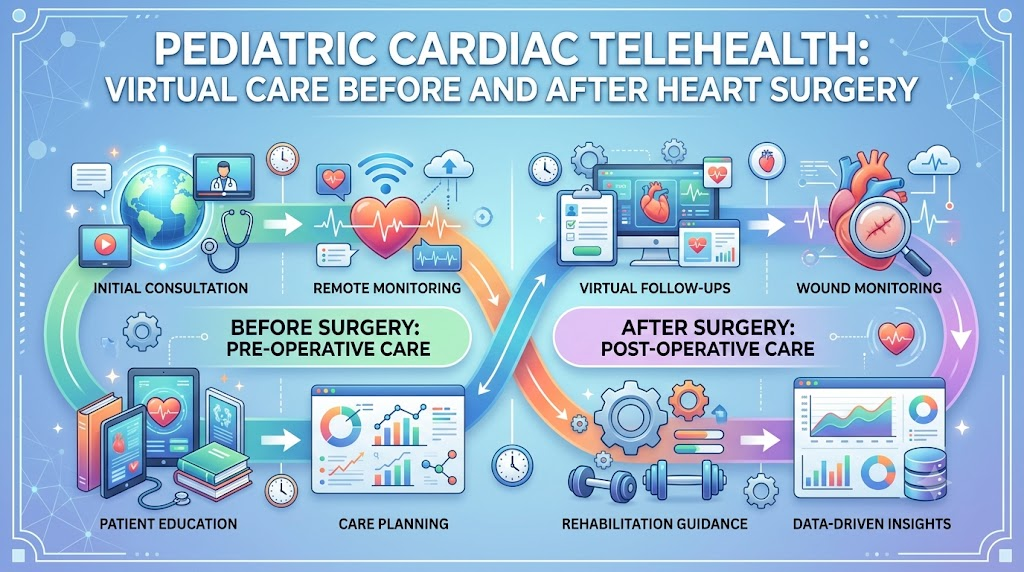
Telehealth Before Pediatric Heart Surgery
A virtual appointment may allow the cardiac team to review the child’s medical history, discuss previous records, explain a planned procedure, and answer questions from parents or caregivers.
The specialist may also explain what preparation is expected before surgery and help coordinate appointments with the local healthcare team.
A virtual consultation does not replace necessary physical examinations, echocardiograms, imaging, blood tests, cardiac catheterization, or other diagnostic evaluations. The tests required depend on the child’s condition and the planned treatment.
Telehealth After Pediatric Heart Surgery
After discharge, selected families may use telehealth after pediatric heart surgery for follow-up discussions.
A virtual appointment may allow the healthcare team to talk about recovery, medicines, feeding, activity, symptoms, upcoming appointments, or caregiver concerns. It can also provide an opportunity to identify whether an in-person assessment is needed.
Families should not wait for a routine virtual appointment if a child develops serious or worsening symptoms or if the cardiac team has given instructions to seek urgent care. In such situations, families should follow their child’s emergency instructions and contact the appropriate medical service promptly.
Remote Monitoring in Pediatric Cardiac Care
Some programs may use remote monitoring for children who need closer observation. Depending on the child’s condition and the hospital’s program, this may involve information such as weight, oxygen levels, breathing, heart rate, or other measurements.
Families should only collect or report specific measurements when the healthcare team has recommended them and explained how to do so.
Remote monitoring is not suitable for every child. The cardiac team decides whether it is appropriate and how the information should be used.
Family Education Through Telehealth
Pediatric cardiac care involves the whole family. Virtual appointments can give parents and caregivers time to ask questions and learn about recovery, medicines, nutrition, appointments, warning signs, and home care.
Good education should match the child’s age and the family’s needs. Parents should feel comfortable asking the healthcare team to explain medical terms or instructions that are unclear.
Telehealth education can complement face-to-face discussions rather than replace them.
How to Prepare a Child for a Telehealth Appointment
Before the appointment, keep the child’s medical records and medication information available. Have recent test results or reports ready if the hospital has requested them.
Choose a quiet, reasonably well-lit space and use a reliable device and internet connection if possible. A parent or caregiver should be available to help the child during the visit.
Write down questions and concerns before the appointment. If the medical team has asked the family to provide home-monitoring information, keep those records nearby.
If technical problems prevent the appointment from starting, contact the hospital’s telehealth support team rather than trying to solve every problem alone.
What Telehealth Cannot Replace
Some parts of pediatric cardiac care require direct medical assessment.
Physical examinations, echocardiograms, imaging, blood tests, cardiac catheterization, surgery, emergency assessments, and other procedures may require an in-person visit.
Telehealth works best as part of a broader care plan that combines virtual services with appropriate hospital-based care. A child may also need to switch from a planned video appointment to an in-person assessment if the medical team feels that direct examination is necessary.
How to Evaluate a Pediatric Cardiac Telehealth Program
Families can look at several practical factors when comparing pediatric heart surgery telehealth programs.
Consider whether pediatric cardiology and cardiac surgery specialists are involved and whether the team has experience with children’s heart conditions. Ask how virtual appointments are connected with in-person examinations and diagnostic testing.
It is also useful to ask about postoperative follow-up, communication with local doctors, caregiver education, language accessibility, privacy, technical support, and procedures for handling urgent concerns.
Every hospital program is different, so families should confirm exactly which services are available.
Privacy, Security, and Communication
Families should use the hospital’s approved telehealth platform and follow its instructions for protecting the child’s health information.
Before the appointment, ask who will participate in the virtual visit and how information from the consultation will be documented. Families should also know how to contact the cardiac team after the appointment and where to seek help if a concern becomes urgent.
Clear communication is especially important in pediatric care because parents and caregivers often coordinate many parts of the child’s treatment.
When an In-Person Visit Is Necessary
A virtual appointment may not be suitable when a child needs a physical examination, urgent testing, or immediate treatment.
New or worsening symptoms, significant changes in the child’s condition, serious postoperative concerns, breathing difficulties, or urgent medication problems may require direct medical assessment.
Families should follow the emergency instructions provided by their child’s cardiac team and seek urgent medical care when serious concerns occur rather than waiting for a telehealth appointment.
Second Opinions and Care Coordination
A pediatric heart surgery virtual consultation may allow a family to discuss medical records and treatment questions with a specialist without immediately traveling to another center, when the hospital and clinical situation allow.
A virtual second opinion does not automatically mean that a different treatment is necessary. Families should discuss recommendations with the child’s treating medical team and make sure all relevant medical records and test results are available.
Telehealth can also support communication between specialist teams and local doctors, helping coordinate different parts of a child’s care.
Common Telehealth Services and Their Limits
| Telehealth Service | How It May Help Families | When In-Person Care May Still Be Needed |
|---|---|---|
| Virtual specialist consultation | Connects families with pediatric cardiac specialists | Physical examination or testing is required |
| Postoperative follow-up | Discusses recovery and caregiver concerns after discharge | Concerning symptoms or changes require direct assessment |
| Family education | Explains care instructions and answers questions | Hands-on teaching or examination may be necessary |
| Remote monitoring | Allows selected health information to be shared with the care team | Abnormal findings may require an in-person evaluation |
| Second opinion | Provides access to another specialist when appropriate | Additional tests or direct examination may be needed |
Limitations of Pediatric Heart Surgery Telehealth Programs
Telehealth can be affected by internet problems, limited device access, privacy concerns, language barriers, and difficulty examining young children remotely.
Some families may also live in areas where reliable virtual services are limited. Regulations and telehealth arrangements can vary by location.
Most importantly, not every child or every stage of cardiac care is suitable for virtual treatment. A hospital may need to convert a telehealth appointment into an in-person visit when the child’s medical needs require it.
FAQs
1. What is a pediatric heart surgery telehealth program?
It is a virtual healthcare service that connects children and caregivers with pediatric cardiac professionals for selected consultations, follow-up, education, and care coordination.
2. Can heart surgery be performed through telehealth?
No. Heart surgery requires appropriate in-person facilities, surgical teams, monitoring, and direct medical care. Telehealth supports selected parts of the care journey.
3. What services may be available before pediatric heart surgery?
Depending on the program, virtual consultations may cover medical history, previous test results, treatment discussions, preparation information, and caregiver questions.
4. How does virtual follow-up work after surgery?
The cardiac team may discuss recovery, medicines, feeding, activity, symptoms, and upcoming care. An in-person visit may still be required when direct assessment is needed.
5. Will children still need some appointments in person?
Yes. Many children will need physical examinations, diagnostic tests, procedures, surgery, or other services that cannot be completed through video.
6. Can remote monitoring be used for children with heart conditions?
Some programs may offer remote monitoring for selected children. The healthcare team should decide what information needs to be monitored and how it should be reported.
7. How should parents prepare for a virtual cardiac appointment?
Keep medical records, medication information, requested test results, questions, and relevant home-monitoring information available. Use a quiet space and have a caregiver present.
8. Can telehealth provide a second opinion?
In some situations, yes. A virtual consultation may allow a family to discuss records and treatment questions with another pediatric cardiac specialist when appropriate.
9. How can families evaluate a hospital’s telehealth program?
Ask about participating specialists, available virtual services, in-person care, follow-up, emergency procedures, privacy, technical support, and communication with local healthcare providers.
10. When should urgent medical care be sought instead of waiting for telehealth?
Serious or worsening symptoms or urgent postoperative concerns should not wait for a routine virtual appointment. Follow the child’s cardiac team’s emergency instructions and seek urgent medical care when needed.
Conclusion
Pediatric heart surgery telehealth programs can make cardiac care more accessible for some families, particularly when specialist centers are far from home. Virtual consultations, education, care coordination, selected follow-up visits, and remote monitoring may support different stages of a child’s care. However, telehealth works best alongside appropriate in-person examinations, diagnostic testing, surgery, and emergency services. Families should ask what a hospital’s program actually provides and how virtual care connects with hospital-based treatment. A qualified pediatric cardiac team can help determine which parts of care are appropriate for telehealth and which require an in-person visit.