Introduction
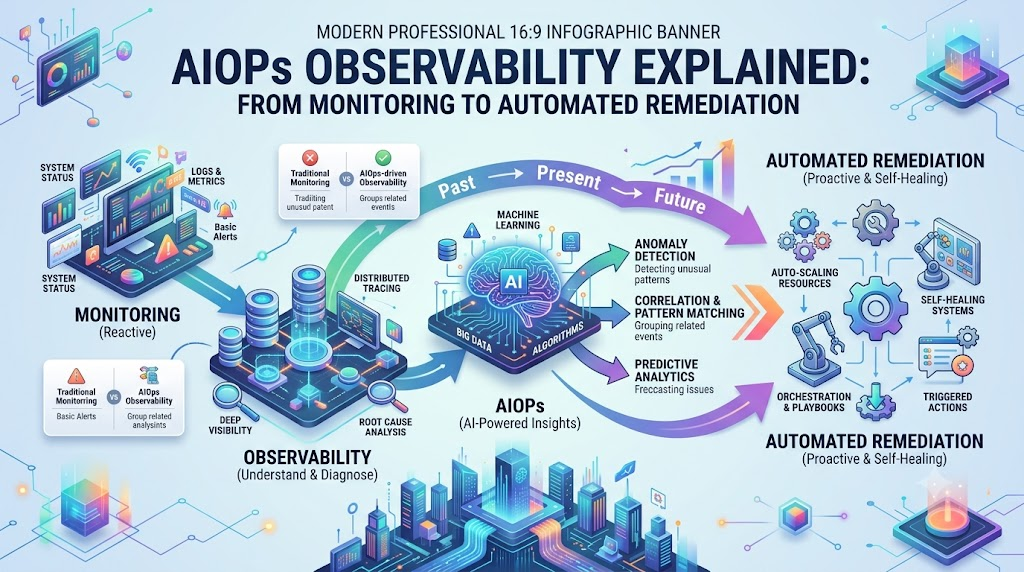
Modern IT environments generate enormous amounts of operational data from applications, servers, networks, databases, containers, and cloud services. Traditional monitoring can show that something is wrong, but identifying why it happened and what should happen next can still require significant manual effort.
This is where AIOps observability becomes valuable. By combining observability data with Artificial Intelligence for IT Operations, organizations can analyze logs, metrics, traces, events, and alerts more intelligently. TheAIOps.com helps professionals understand these technologies and the practical skills required to apply them. In this guide, we will explore how AIOps and observability work together, where they provide value, implementation considerations, and how teams can introduce automation without losing operational control.
What Is AIOps Observability?
AIOps observability combines broad visibility into IT systems with machine learning, analytics, and automation.
Observability refers to the ability to understand the internal state of a system by examining the data it produces. The three commonly discussed observability signals are logs, metrics, and traces.
AIOps, or Artificial Intelligence for IT Operations, applies techniques such as machine learning, anomaly detection, event correlation, and predictive analytics to operational data.
Together, they provide a more intelligent approach to understanding complex environments. Instead of examining thousands of alerts individually, operations teams can use AIOps capabilities to identify relationships between events and focus attention on potentially meaningful incidents.
Why Traditional Monitoring Is Not Always Enough
Monitoring remains essential, but modern environments have become increasingly distributed.
A single customer transaction might pass through an API gateway, several microservices, a Kubernetes cluster, databases, third-party services, and cloud infrastructure. A problem in one component can therefore create multiple alerts across different monitoring systems.
For example, a database slowdown may cause application latency, which then generates service alerts and potentially triggers infrastructure warnings. Without sufficient context, engineers may investigate each alert separately.
AIOps can correlate related events and provide additional context, helping teams distinguish symptoms from potentially related underlying conditions.
How AIOps and Observability Work Together
The process generally involves collecting operational information from multiple sources and applying analytics to that information.
1. Collect Operational Data
An organization may collect:
- Application logs
- Infrastructure metrics
- Distributed traces
- Network events
- Kubernetes events
- Database performance information
- Security and service-management events
The objective is to establish a useful operational data foundation.
2. Analyze and Detect Anomalies
Machine-learning models and statistical techniques can identify behavior that differs from established patterns.
For example, an application normally processes a particular number of requests per minute. A sudden change in request latency, error rates, or resource consumption may be identified as an anomaly.
Anomaly detection does not automatically mean that a failure has occurred. Engineers still need context to determine whether the behavior represents a genuine operational problem.
3. Correlate Related Events
Event correlation connects potentially related alerts and observations.
Suppose several applications become slow shortly after a network component starts experiencing packet loss. An AIOps Platform may analyze timing and relationships between these signals and group them into a related incident.
This can reduce duplicate alerts and give engineers a more organized view of the situation.
4. Support Root-Cause Analysis
Root-cause analysis attempts to identify the underlying condition responsible for an incident.
AIOps can combine historical information, dependencies, events, metrics, logs, and traces to provide evidence that may assist engineers during investigation.
The quality of the result depends heavily on data quality, system architecture, integrations, and model configuration.
Key Capabilities of AIOps Observability
| Capability | Benefit | Practical Example |
|---|---|---|
| Anomaly detection | Identifies unusual system behavior | Detecting an unexpected increase in application latency |
| Event correlation | Groups related operational events | Connecting application errors with an infrastructure change |
| Root-cause analysis | Provides investigation context | Linking service degradation to a dependent database |
| Automated remediation | Can execute approved responses | Restarting a failed non-critical service under defined conditions |
These capabilities are most useful when they are connected to reliable operational processes rather than deployed simply to generate more alerts or automation.
AIOps Tools and Platform Considerations
The AIOps Tools selected by an organization should fit its existing technology environment.
Useful evaluation areas include observability integrations, support for logs and metrics, distributed tracing, event correlation, anomaly detection, incident management integration, APIs, scalability, security, and automation capabilities.
Integration is particularly important. An AIOps solution that cannot access relevant operational data may provide limited context.
Organizations should also evaluate access controls, deployment options, customization, reporting, auditability, and governance before introducing automation into production environments.
Practical AIOps Use Cases
AIOps observability can support several IT operations scenarios.
Cloud Infrastructure
Cloud environments produce large volumes of telemetry. AIOps can analyze infrastructure behavior and help identify unusual resource consumption or relationships between service events.
Kubernetes and Microservices
Kubernetes environments can generate events across nodes, pods, containers, services, and deployments. Correlating this information can make incident investigation more manageable.
Application Performance
Combining application metrics, logs, and traces can provide better context around latency and errors. AIOps analytics may help identify unusual patterns before they become larger operational incidents.
Incident Management
AIOps can enrich incidents with related events and historical information. This can help engineers investigate problems without manually switching between numerous monitoring systems.
Automated Remediation
Automation can be introduced after teams understand recurring operational patterns. For example, a predefined action could be triggered when a known condition occurs, provided that the action has been tested and approved.
A Practical AIOps Implementation Approach
Successful AIOps Implementation generally starts with a specific operational problem rather than attempting to automate everything simultaneously.
Teams can begin by identifying high-value use cases such as alert-noise reduction, anomaly detection, or incident enrichment. They can then assess existing observability coverage and determine whether important logs, metrics, traces, and events are available.
After integrating relevant data sources, teams can establish baseline behavior and test correlation or anomaly-detection capabilities.
Automation should generally be introduced gradually. Low-risk, reversible actions can be evaluated before allowing automated responses to affect critical production systems.
Security and Governance Matter
AIOps can interact with sensitive infrastructure and operational systems, so security cannot be treated as an afterthought.
Teams should apply least-privilege access, protect operational data, maintain audit trails, and establish clear approval policies. Automated remediation should have defined boundaries and, where appropriate, human approval.
Testing, rollback procedures, change management, and monitoring of automated actions are especially important. An automation system that performs an incorrect action can potentially increase the impact of an incident.
Skills Needed for AIOps Professionals
Professionals interested in becoming an AIOps Engineer benefit from understanding several areas rather than focusing exclusively on machine learning.
Useful skills include cloud infrastructure, Linux, networking, monitoring, observability, scripting, automation, incident management, DevOps, SRE practices, and data analysis.
An AIOps Course can provide structured learning around AIOps architecture, observability, tools, implementation, analytics, and automation. AIOps Training can complement this with practical exercises and operational scenarios.
An AIOps Certification may also help demonstrate knowledge of relevant concepts, although certification requirements and recognition vary between programs and organizations.
For companies, AIOps Consulting and AIOps Services can provide specialized expertise when internal teams need assistance with architecture, integration, implementation, or operational transformation.
Common Mistakes to Avoid
AIOps projects can struggle when organizations focus on technology before defining the operational problem.
Common mistakes include integrating poor-quality data, sending every available event into a platform, automating actions without sufficient testing, ignoring existing workflows, and expecting machine learning to identify every root cause automatically.
Teams should establish measurable objectives and continuously review whether the implementation is actually improving operational workflows.
The Future of AIOps Observability
AIOps and observability are likely to become increasingly connected as infrastructure becomes more distributed and operational data continues to grow.
Future implementations may place greater emphasis on predictive analytics, intelligent incident investigation, natural-language interfaces, topology awareness, and controlled automation.
The underlying principle remains practical: collect useful operational data, understand system relationships, apply analytics carefully, and automate only where the expected benefit and risk are understood.
FAQs
1. What is AIOps observability?
AIOps observability combines observability data such as logs, metrics, and traces with AI and machine-learning techniques to analyze IT operations more intelligently.
2. How is AIOps different from traditional monitoring?
Traditional monitoring primarily detects and reports conditions. AIOps adds capabilities such as event correlation, anomaly detection, analytics, and automation to help teams interpret operational information.
3. What data does AIOps observability use?
It can use logs, metrics, traces, infrastructure events, application data, network information, database telemetry, Kubernetes events, and incident-management information.
4. Can AIOps reduce alert noise?
Yes. Event correlation and intelligent filtering can group related alerts and reduce duplicate or low-value notifications, depending on data quality and configuration.
5. Does AIOps automatically find the root cause?
Not always. AIOps can provide relationships and evidence that support root-cause analysis, but results depend on available data, integrations, system complexity, and implementation quality.
6. How does AIOps work with Kubernetes?
AIOps can analyze Kubernetes metrics, events, logs, and other telemetry to identify unusual behavior and correlate events across containers, pods, services, and infrastructure.
7. Is AIOps useful for DevOps and SRE teams?
Yes. AIOps can complement DevOps and SRE workflows by supporting observability, incident investigation, anomaly detection, operational analytics, and controlled automation.
8. What should organizations consider when selecting an AIOps Platform?
Organizations should examine integrations, observability capabilities, event correlation, analytics, automation, scalability, APIs, security, access controls, deployment options, and governance.
9. What skills should an AIOps Engineer develop?
An AIOps Engineer may need skills in observability, cloud infrastructure, monitoring, automation, scripting, DevOps, SRE, incident management, data analysis, and AI or machine-learning concepts.
10. Should automated remediation be enabled immediately?
No. Organizations should test automation carefully, establish appropriate permissions and safeguards, define rollback procedures, and begin with controlled, low-risk use cases before expanding automation.
Conclusion
AIOps observability brings together operational visibility, intelligent analytics, and controlled automation to address the complexity of modern IT environments. By combining logs, metrics, traces, events, and contextual information, teams can improve anomaly detection, event correlation, incident investigation, and operational decision-making. The strongest implementations begin with clear use cases, reliable data, appropriate governance, and gradual automation. For IT professionals, developing observability, cloud, automation, DevOps, and AIOps skills can provide a practical foundation for working with increasingly intelligent IT operations.