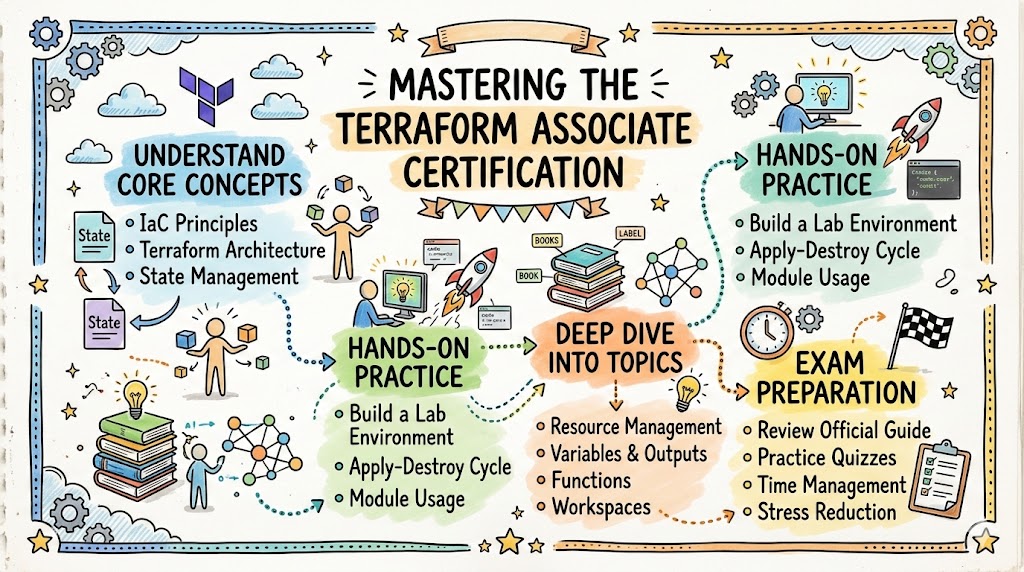
Modern infrastructure teams can no longer depend on manual clicks in cloud consoles. They need fast, repeatable, and safe automation for every environment. HashiCorp Terraform has become one of the most widely adopted tools for Infrastructure as Code (IaC), and the HashiCorp Certified: Terraform Associate certification is the official way to prove you can use it properly in real projects.This guide will walk you through what the certification is, who should take it, the skills you will gain, how to prepare, and how it fits into bigger DevOps, SRE, and cloud career paths.
What is HashiCorp Certified: Terraform Associate?
The Hashicorp Certified Terraform Associate certification validates your understanding of Terraform fundamentals, IaC concepts, and the ability to use Terraform to provision and manage real infrastructure. It is designed for professionals who work with Terraform in day-to-day infrastructure automation, cloud provisioning, and DevOps workflows.
You are tested on concepts like Terraform workflow (init, plan, apply, destroy), configuration language (HCL), providers, state management, modules, and best practices for secure and collaborative use.
Why This Certification Matters
- It proves that you can manage infrastructure using code instead of manual steps.
- It shows you understand Terraform’s role across AWS, Azure, GCP, and other providers.
- It helps DevOps, SRE, platform, and cloud engineers stand out in a crowded job market.
- Many teams already use Terraform in production, so certified professionals are in high demand.
For working engineers and managers, this certification sends a clear signal that you understand modern infrastructure workflows and can support reliable, scalable delivery.
Key Details: HashiCorp Certified Terraform Associate
What it is
The HashiCorp Certified: Terraform Associate is an entry-to-mid-level certification that validates your ability to use Terraform for Infrastructure as Code across cloud and on-prem environments. It covers both conceptual understanding and hands-on skills needed to write, run, and manage Terraform configurations safely.
Who should take it
- DevOps Engineers and SREs working with cloud infrastructure.
- Platform and Cloud Engineers managing multi-environment deployments.
- System Administrators moving from scripts and manual steps to IaC.
- Developers who frequently interact with infra, previews, or sandbox environments.
- Engineering Managers who want a solid baseline understanding of IaC practices.
Skills you’ll gain
- Understanding IaC concepts and Terraform’s purpose.
- Writing Terraform configuration in HCL (variables, outputs, resources, data sources).
- Working with providers and modules to structure reusable infrastructure.
- Managing state locally and remotely, including backends and state locking.
- Using the Terraform workflow: init, validate, plan, apply, destroy.
- Handling secrets and sensitive data following security best practices.
- Integrating Terraform into CI/CD and collaborative workflows.
Real-world projects you should be able to do after it
After preparing for this certification, you should be comfortable doing projects like:
- Provision a complete VPC with subnets, security groups, and instances in AWS using Terraform.
- Deploy a three-tier application (database, backend, frontend) using modules and remote state.
- Implement multi-environment infrastructure (dev, stage, prod) with workspaces and variables.
- Migrate manually created resources into Terraform state safely.
- Wire Terraform into a CI/CD pipeline so infrastructure changes are reviewed and applied in a controlled way.
Certification Table
Below is a structured view of the main certification you are focusing on, including how it maps to track, level, and recommended order in a broader learning path.
| Certification | Track | Level | Who it’s for | Prerequisites | Skills covered | Recommended order |
|---|---|---|---|---|---|---|
| HashiCorp Certified: Terraform Associate | DevOps / Automation | Associate | DevOps, SRE, Cloud, Platform, and System Engineers using or planning to use Terraform | Basic Linux, cloud basics (AWS/Azure/GCP), understanding of infra concepts (VPC, VM, networking) | IaC concepts, Terraform workflow, HCL, providers, modules, state, collaboration, security best practices | After DevOps foundation, before advanced platform/SRE or MDE-level programs |
Preparation Plan: 7–14 Days, 30 Days, 60 Days
7–14 Days (Fast-track refresher)
Best for: people already using Terraform at work.
- Revise IaC fundamentals and Terraform’s core concepts and workflow.
- Go through the official exam objectives and map them to your daily work.
- Focus on weak areas: modules, state backends, and security.
- Attempt focused labs: provisioning infra, modifying it, and destroying it cleanly.
- Solve practice questions under time pressure to get used to exam style.
30 Days (Standard working-professional plan)
Best for: working engineers with limited daily time.
- Week 1: Learn or revise IaC, Terraform basics, installation, providers, and simple configurations.
- Week 2: Work on variables, outputs, data sources, and modules; refactor simple configs into reusable modules.
- Week 3: Deep dive into state management (local vs remote), backends, workspaces, and collaboration workflows.
- Week 4: Full mock projects that simulate real environments plus multiple practice exams.
60 Days (From scratch / role transition)
Best for: people new to Terraform or moving from traditional sysadmin roles.
- Phase 1 (first 20 days):
- Learn Linux basics, cloud fundamentals, and basic networking if needed.
- Understand IaC concepts, why Terraform exists, and how it compares to other tools.
- Phase 2 (next 20 days):
- Hands-on Terraform: install it, write basic configs, use providers, variables, outputs, and modules.
- Build small but complete environments (e.g., single app + database) on one cloud provider.
- Phase 3 (final 20 days):
Common Mistakes to Avoid
- Learning Terraform commands by heart without understanding IaC concepts and the workflow.
- Ignoring state management; not understanding backends, locking, or implications of manual state edits.
- Writing large, monolithic configuration files instead of using modules and proper structure.
- Treating Terraform like a scripting tool instead of a declarative infrastructure model.
- Not practicing with real cloud accounts and real-world scenarios.
- Underestimating the exam by skipping hands-on labs and relying only on theory.
Best Next Certification After Terraform Associate
After completing HashiCorp Certified: Terraform Associate, strong next steps often come from broader DevOps and automation programs that combine CI/CD, containers, Kubernetes, monitoring, and reliability. DevOpsSchool’s Master in DevOps Engineering (MDE) is designed to cover this wider ecosystem and can sit as a natural next layer after Terraform.
You can pick next certifications based on your chosen path:
- Same track (Automation/DevOps): move into more advanced DevOps or Infrastructure automation programs, where Terraform is combined with Kubernetes and configuration management.
- Cross-track (SRE, DevSecOps, DataOps): extend Terraform knowledge into reliability, security, or data-focused roles.
- Leadership: consider broader DevOps architecture and leadership certifications that focus on designing and governing end-to-end delivery systems.
(Next-certification options are detailed again in the “Next certifications to take” section below.)
Choose Your Path: 6 Learning Paths
Terraform Associate can plug into different long-term specializations. Here is how it fits inside six popular tracks.
DevOps Path
- Focus: CI/CD, automation, containers, infrastructure, and cloud delivery.
- Terraform role: core IaC tool for defining and managing infra used by pipelines and applications.
- Long-term skills: Git, CI/CD tools, Docker, Kubernetes, Terraform, configuration management, observability.
DevSecOps Path
- Focus: integrating security into every stage of development and operations.
- Terraform role: enforcing secure defaults in infrastructure, integrating with policy-as-code and security scanners.
- Long-term skills: SAST/DAST tools, secrets management, compliance automation, policy-as-code.
SRE Path
- Focus: reliability, availability, performance, and incident management.
- Terraform role: defining reliable infra patterns (load balancers, autoscaling, multi-zone setups) and repeatable rollbacks.
- Long-term skills: SLOs, error budgets, observability, incident response, chaos testing, capacity planning.
AIOps/MLOps Path
- Focus: automating operations and ML workflows using data and intelligent tooling.
- Terraform role: provisioning repeatable environments for ML training, inference, and data pipelines.
- Long-term skills: pipelines for ML, monitoring ML systems, scaling compute and storage, integrating AI-based ops tooling.
DataOps Path
- Focus: reliable, automated, and governed data pipelines and platforms.
- Terraform role: provisioning data platforms (databases, warehouses, streaming infra) using code.
- Long-term skills: ETL/ELT tools, streaming platforms, data governance, automated pipeline deployment.
FinOps Path
- Focus: controlling and optimizing cloud costs while enabling fast product delivery.
- Terraform role: standardizing cost-conscious infrastructure patterns and enforcing budgets via modules and policies.
- Long-term skills: cloud cost analysis, tagging strategies, rightsizing, showback/chargeback, cost-aware architecture.
Role → Recommended Certifications Mapping
Here is how HashiCorp Certified Terraform Associate can fit into a broader certification map for different roles.
Next Certifications to Take (Same track, Cross-track, Leadership)
Based on the broader certification ecosystem around DevOps and MDE-style programs, you can think of next certifications using three angles.
1. Same Track (Automation / DevOps)
You can deepen your automation and DevOps expertise by moving to comprehensive programs that cover CI/CD, containers, Kubernetes, configuration management, and observability together. These programs often position Terraform as one of several core tools and give you an end-to-end delivery perspective.
2. Cross-Track (DevSecOps, SRE, AIOps/MLOps, DataOps, FinOps)
Once you are comfortable with Terraform and IaC, cross-track certifications help you specialize:
- DevSecOps: focus on embedding security into infra pipelines.
- SRE: focus on reliability and performance with infra, observability, and processes.
- AIOps/MLOps: focus on intelligent operations or ML workflows running on cloud infra.
- DataOps: focus on automating data pipelines and platforms.
- FinOps: focus on cloud cost control and optimization with infra patterns.
These certifications build on your Terraform skills and connect them to specific outcomes like security, reliability, data, or cost.
3. Leadership
For engineers moving towards tech lead, architect, or manager roles, leadership-oriented DevOps programs help you:
- Design full delivery pipelines end to end.
- Define standards and guardrails for how Terraform and other tools are used.
- Align infra, security, and cost with business goals.
In this phase, Terraform Associate becomes a foundation to understand the technical depth behind decisions you are making at the design and governance level.
Top Institutions for HashiCorp Certified Terraform Associate Training
Several specialist institutions provide structured training and guidance for this certification, combining theory, labs, and career-focused support.
DevOpsSchool
DevOpsSchool offers dedicated Terraform Associate training that combines live sessions, hands-on labs, and exam-focused preparation. The curriculum covers core Terraform concepts, HCL, providers, modules, state management, and best practices aligned with the exam blueprint. You also get access to learning materials, doubt-clearing support, and guidance on how to connect Terraform skills with broader DevOps roles and interviews.
Cotocus
Cotocus works as a consulting and training organization that helps professionals upgrade their DevOps and cloud skills, including Terraform. It typically focuses on real-world use cases, group coaching, and career-oriented mentoring so that you do not just pass the exam but also apply Terraform at work with confidence. Learners benefit from structured learning paths that fit DevOps, SRE, and platform engineering journeys.
ScmGalaxy
ScmGalaxy provides DevOps training and workshops that include Terraform as part of infrastructure automation and environment management. Programs often include practical labs, scenario-based assignments, and exposure to related tools like CI/CD, configuration management, and containers. This helps you see how Terraform fits into the complete software delivery lifecycle.
BestDevOps
BestDevOps focuses on high-impact DevOps and cloud courses oriented towards working professionals. Its Terraform-related offerings are structured to quickly build IaC skills, address real project scenarios, and connect those skills with better career outcomes. The emphasis is on practical understanding rather than just theoretical exam prep.
DevSecOpsSchool
DevSecOpsSchool positions Terraform inside a security-first automation viewpoint, which is important for teams where security is tightly integrated with infra. Training emphasizes secure defaults, policy-as-code, and integrating Terraform into secure pipelines. This is useful for professionals targeting DevSecOps or security-focused roles.
SRESchool
SRESchool is centered on Site Reliability Engineering and often includes Terraform as a foundational tool for defining reliable infrastructure. Its programs combine concepts like SLOs, monitoring, and incident response with IaC and automation practices. This helps SREs use Terraform to build and maintain stable, observable platforms.
AIOpsSchool
AIOpsSchool focuses on applying automation and intelligence to IT operations, where Terraform is used to provision underlying platforms. Training may include how to combine Terraform with monitoring, analytics, and AI-driven insights for proactive operations. This is a strong fit if you plan to move into AIOps or MLOps-focused roles that depend on standardized infra.
DataOpsSchool
DataOpsSchool aligns Terraform training with data platform engineering and pipeline automation. Programs highlight how to provision data infrastructure, orchestrate environments, and support data teams using IaC. This is ideal for data engineers or platform engineers working closely with analytics teams.
FinOpsSchool
FinOpsSchool focuses on cloud cost optimization and financial governance for engineering teams. Terraform is presented as a key tool to encode cost-efficient patterns, tagging standards, and guardrails directly into infrastructure definitions. This is valuable for engineers and practitioners who want to connect infra automation with financial outcomes.
FAQs on HashiCorp Certified Terraform Associate
1. What is the HashiCorp Certified Terraform Associate exam about?
It focuses on Terraform fundamentals, IaC concepts, and the Terraform workflow, including configuration, state management, modules, and collaboration.
2. How difficult is the Terraform Associate exam?
For someone with hands-on Terraform experience, it is moderate. For beginners, it becomes manageable with 30–60 days of structured study and real lab practice.
3. Do I need cloud provider certifications before taking this?
You do not need a cloud-specific certification, but you should understand basic cloud concepts like VMs, networks, storage, and IAM. A cloud certification can help, but it is not mandatory.
4. Can freshers or entry-level engineers take this exam?
Yes, motivated freshers can take it if they are ready to invest time in learning Terraform and basic cloud concepts. However, people with some infra or DevOps exposure usually find it easier.
5. How long does it take to prepare?
- With strong Terraform experience: 7–14 days of focused revision.
- With some Terraform and cloud basics: around 30 days with consistent practice.
- From scratch: about 60 days including learning cloud and Linux basics.
6. What topics should I focus on the most?
Pay special attention to Terraform workflow, providers, variables, outputs, data sources, modules, and state management. Also understand security best practices and collaboration patterns.
7. Is this certification useful if my company does not use Terraform yet?
Yes, it prepares you for future roles in organizations that already rely on Terraform. It also allows you to advocate for and introduce IaC practices in your current team.
8. How does this certification compare to other IaC tools?
The exam focuses only on Terraform, but you will also learn general IaC ideas applicable to other tools. Terraform’s multi-cloud and provider ecosystem make it a strong first choice.
9. Can this certification help me switch to a DevOps or SRE role?
Yes, Terraform Associate is a strong proof point when you apply for DevOps, SRE, platform, or cloud engineering roles, especially when combined with real project experience. Employers value IaC skills as a core capability in these roles.
10. Do I need programming skills to pass?
You do not need deep programming expertise, but you should be comfortable reading and writing structured configuration (HCL), understanding variables and basic expressions. Shell scripting and Git knowledge are also helpful.
11. How should I practice for the exam?
Use real cloud accounts and build complete environments using Terraform, not just isolated resources. Combine this with mock exams and topic-wise revision.
12. Is Terraform Associate enough, or should I combine it with other certifications?
It is a strong starting point but becomes more powerful when combined with DevOps, cloud, SRE, or specialization certifications. Think of it as your IaC foundation within a bigger career roadmap.
HashiCorp Certified Terraform Associate
These can be used as a compact FAQ block if you need a shorter version.
- Is prior Terraform experience required?
Some hands-on practice is strongly recommended, but beginners can prepare in 30–60 days with structured learning and labs. - Which roles benefit the most from this certification?
DevOps Engineers, SREs, platform engineers, and cloud engineers gain the most immediate value. - Does the exam cover only one cloud provider?
No, it focuses on Terraform itself, which supports many providers, including AWS, Azure, and GCP. - How much hands-on practice should I do?
Plan to build multiple end-to-end environments and intentionally modify and destroy them using Terraform. - Is Terraform Associate good for managers?
Yes, it gives managers a clear view of modern infra workflows and helps in setting realistic expectations and standards. - Can I prepare using only online courses?
Courses help, but you should always combine them with real lab work and experiments in a cloud environment. - Does this certification expire?
HashiCorp periodically updates and refreshes certifications; you should always check the latest validity and version on the official certification page. - What is the best high-level study approach?
Understand concepts first, then practice configurations, then take mock exams and fix gaps in a final review cycle.
Conclusion
HashiCorp Certified: Terraform Associate is one of the most practical and impactful certifications for today’s cloud and DevOps ecosystem. It proves that you can design, codify, and manage infrastructure reliably using Terraform instead of manual steps. For working engineers, it strengthens your day-to-day skills and opens up roles in DevOps, SRE, platform, and cloud engineering. For managers, it offers a solid technical baseline to guide teams towards safer, more standardized infrastructure practices. If you follow a structured preparation plan, focus on real projects, and connect it with a broader learning path, this certification can become a strong pillar in your long-term career growth.